

Aaron Bing: The Long Road Behind the Saxophone

From a seventh-grade clarinet to a career spanning seven albums, film and television work, millions of streams, and a growing entertainment empire, Aaron Bing’s story is less about overnight success than what happens when an artist refuses to stop evolving.
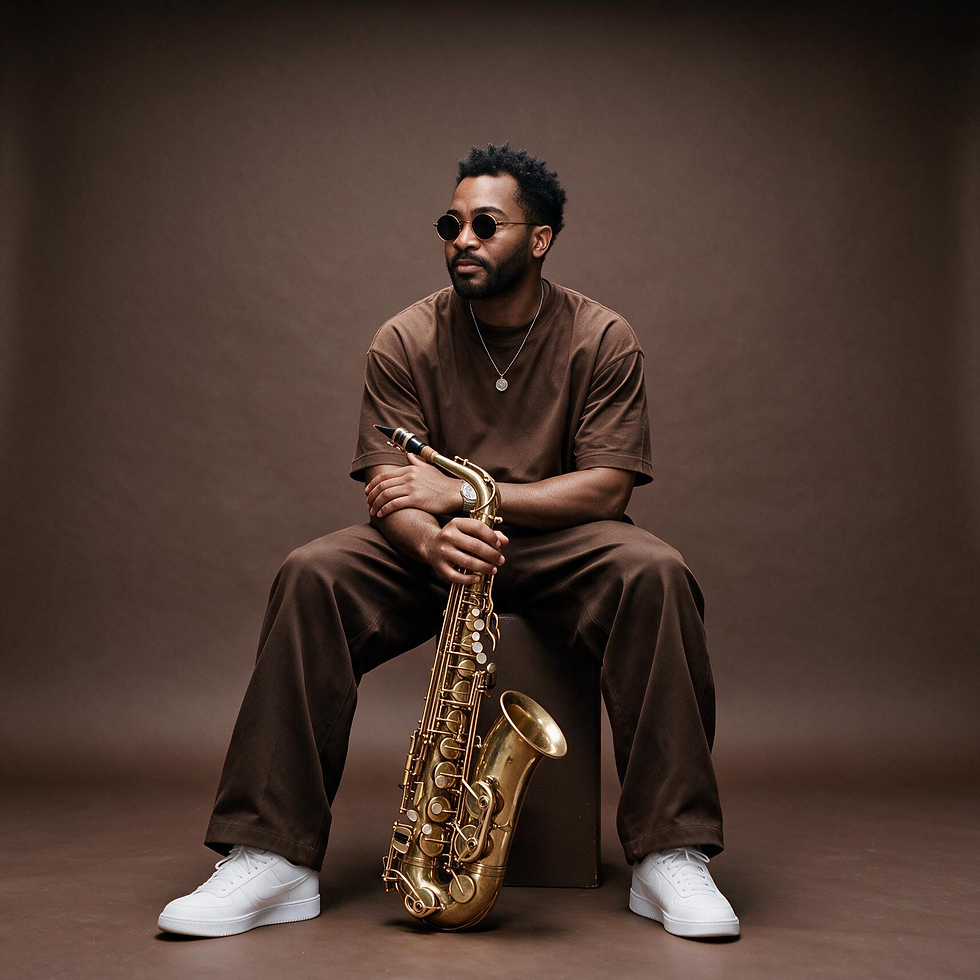
LOS ANGELES, CA — The photograph is striking in its simplicity.
Aaron Bing sits centered against a warm, understated backdrop, dressed in deep earth tones with dark sunglasses and a saxophone resting between him. There is no stage, no audience and no performance in progress. Instead, the image captures something more personal: an artist at ease with the instrument that has become inseparable from his identity.
For someone whose career has stretched across more than two decades of recording, performing, producing, composing and building businesses around music and entertainment, the portrait feels less like a publicity shot and more like a statement.
The saxophone is not being presented as a prop.
It feels like part of the story.
And for Aaron Bing, that story began long before the albums, streams, red carpets and entertainment-industry opportunities that would eventually follow.

Before the Saxophone
Bing's first connection to music did not come through a major conservatory, private instructor or carefully mapped-out career plan.
It began in seventh grade with his aunt's clarinet.
What followed was largely self-directed.
Curiosity became practice. Practice became discipline. And discipline gradually became musicianship.
Bing would eventually teach himself to play 21 instruments, but among all of them, the saxophone emerged as the instrument through which he could communicate most naturally.
It gave him something words could not.
A musical voice.
That voice would eventually become the foundation of a career blending smooth jazz with pop, R&B, gospel and Latin influences, creating a sound that has continued to evolve alongside the artist himself.
His music also carries elements of his own background and heritage, with Bing drawing from both his African American and Dominican roots while refusing to remain confined to a single musical category.
For Bing, genre has often functioned more as a starting point than a boundary.
Building a Career One Record at a Time
In 2005, Aaron Bing released his debut album, Always.
There was no guarantee that another album would follow.
It did.
And then another.
Over the years, Bing built a seven-album catalog that includes Always, Christmas Dream, Softwinds, Rebirth, Otra Parte De Mí, Awakening and the self-titled Aaron Bing.
The records documented more than musical progression.
They captured different chapters of an artist attempting to understand where instrumental music could fit inside an industry increasingly dominated by vocals, celebrity culture and rapidly changing trends.
Rather than abandon the saxophone, Bing kept looking for new ways to make it relevant.
Sometimes that meant leaning into smooth jazz.
Sometimes it meant incorporating pop and contemporary R&B.
Sometimes it meant introducing vocals.
And with Otra Parte De Mí, it also meant exploring the influence of his Dominican heritage and Latin musical identity.
That refusal to remain static would become one of the defining characteristics of his career.
Today, Bing's catalog has generated millions of streams, with his self-titled album alone surpassing significant streaming milestones while his overall body of work continues reaching listeners around the world.
But numbers are only one measure of the journey.
The more revealing story is everything that happened between the releases.


The Rooms Artists Spend Years Trying to Enter
As Bing's career expanded, so did the environments around him.
The saxophonist who began with his aunt's clarinet eventually found himself working, performing or appearing in entertainment spaces connected to some of the most recognizable names in music and popular culture.
His career has intersected with artists and entertainers including Gladys Knight, Brian McKnight, Tyrese Gibson, Michael Bolton, Will Smith, Camila Cabello, Nick Jonas, James Corden, Lupita Nyong'o, Billie Eilish and others.
He has appeared around events ranging from major awards-season gatherings and red carpets to performances and industry functions tied to some of entertainment's largest platforms.
Those moments can make a career appear seamless when viewed from the outside.
It rarely is.
Behind nearly every visible milestone are years of unanswered calls, rejected ideas, financing challenges, projects that never reached the public and opportunities that disappeared before an audience ever knew they existed.
For Bing, those realities became part of the education.
Not just as an artist.
As a businessman.

When Being an Artist Was No Longer Enough
At some point in Aaron Bing's career, simply making music stopped being enough.
Not because music mattered less.
Because understanding the business surrounding the music began to matter more.
Bing gradually moved beyond being only the person standing in front of the microphone.
He became involved in recording.
Production.
Concert promotion.
Film audio.
Artist development.
Business development.
And eventually ownership.
That evolution led to the creation and development of companies including Century Studios, Century Records and Vibe Media Live.
Each represented a different extension of the same principle:
If the infrastructure did not exist around him, he would attempt to build it.
Century Studios expanded Bing's work into professional recording, mixing, mastering, ADR, Foley, audio restoration, film post-production and live recording.
Vibe Media Live broadened the vision into live entertainment, concerts, tours, sponsorships and large-scale event development.
Century Records became the label side of the equation, allowing Bing to move from developing his own career to creating platforms for other artists.
The musician had become an entrepreneur.
But unlike many executives who move away from the creative side once the business grows, Bing never completely separated the two.
The saxophone remained in the room.
A Different Kind of Independence
The word "independent" is often used casually in music.
For Bing, independence has rarely meant doing everything alone.
It has meant learning enough about every part of the process to understand what happens when the music leaves the studio.
How records are distributed.
How promotions work.
How touring works.
How sponsorship works.
How film licensing works.
How artist negotiations work.
How deals fail.
And perhaps most importantly, how artists can lose control of their careers when they do not understand the business behind them.
Those lessons were not always comfortable.
Some came through success.
Others came through loss.
Like many entrepreneurs, Bing has experienced periods when ambitious projects did not unfold as expected, funding fell through, partnerships changed and business setbacks carried very real consequences.
Those chapters rarely appear in the glamorous version of the entertainment industry.
But they are part of Bing's story.
And they help explain why his career today extends so far beyond releasing records.
He became interested not only in making music, but in understanding the machinery surrounding it.
From Records to Film
Music eventually led Bing into another creative world.
Film.
His work expanded into scoring and post-production, including projects such as Flint Tale, Sasha Lane and Black Skin, connected to filmmaker Marc Cayce.
His involvement with film and television audio also included ADR and post-production work through Century Studios, with projects associated with major television and streaming productions.
For a musician who began by teaching himself instruments, entering film scoring was another natural extension of the same instinct that had shaped his career from the beginning:
Learn.
Experiment.
Expand.
Then figure out what comes next.
Bing's work on Flint Tale would eventually receive consideration in connection with the Academy Awards' Best Original Score category, adding yet another unexpected chapter to a career that has rarely followed a straight line.


Seven Albums Later, the Question Changes
Early in an artist's career, the question is usually simple:
Can you make it?
Twenty years later, the question becomes different.
Can you remain relevant?
Can you continue to evolve without becoming unrecognizable?
Can you survive an industry that reinvents itself every few years?
Can you still find something worth saying after the excitement of being "new" disappears?
That may be the more interesting stage of Aaron Bing's career.
Because he is no longer attempting to prove that he can release an album.
He has already released seven.
He is no longer attempting to prove that audiences will listen.
Millions already have.
He is no longer attempting to prove that he can work beyond instrumental jazz.
His career has crossed pop, R&B, gospel, Latin music, film, television and live entertainment.
The challenge now is something else entirely:
What does the next version of Aaron Bing sound like?

The Evolution of the Sound
Recent material has suggested an artist increasingly comfortable placing the saxophone inside contemporary pop and R&B rather than asking listeners to enter a traditional smooth-jazz environment first.
That distinction matters.
For Bing, the goal appears increasingly centered on making the saxophone feel current rather than nostalgic.
Songs such as "Take A Look" continue that progression, combining Bing's saxophone identity with more contemporary vocal and production elements.
Other projects, including "Forgive Me" featuring Breana Marin, move into a more spiritual and emotional direction, pairing saxophone and vocals around themes of prayer, accountability and forgiveness.
It is less about abandoning the foundation that built his audience and more about widening the frame around it.
The saxophone stays.
The world surrounding it changes.

The Man Behind the Instrument
Which brings the story back to the photograph.
Aaron Bing is seated beside the saxophone rather than holding it.
That seemingly small detail makes the image feel different.
The instrument is present, but it does not dominate him.
Perhaps that is fitting at this point in his life.
For years, the simplest description of Bing was "saxophonist."
It is still accurate.
It is simply no longer complete.
He is a composer.
Producer.
Multi-instrumentalist.
Recording-studio owner.
Label executive.
Concert promoter.
Entrepreneur.
Film composer.
Artist developer.
And yet none of those titles completely replaces the boy who picked up a clarinet in seventh grade and became curious about how far music might take him.
That may ultimately be the most important part of the story.

There Was Never an Overnight Success
Entertainment culture loves the mythology of discovery.
One video goes viral.
One song changes everything.
One person gets the right meeting.
One night creates the career.
Aaron Bing's journey does not fit comfortably inside that mythology.
There was no single moment.
There were thousands of them.
A first instrument.
A first song.
A first album.
A second album.
A failed idea.
Another opportunity.
A business decision.
A studio.
A film.
A concert.
A setback.
Another record.
Another reinvention.
Another morning when continuing would have been easier to postpone.
And eventually, those moments became a career.
That career has now stretched across more than two decades.

Still Betting on Himself
There is a temptation in the music industry to treat longevity as something that simply happens.
It doesn't.
Longevity requires adaptation.
And adaptation usually requires an artist to become comfortable with being uncomfortable.
Bing's willingness to move between instrumental music, contemporary pop, production, film, business and artist development has sometimes made his career difficult to categorize.
But perhaps categorization was never the point.
The point was survival.
Creation.
Ownership.
Growth.
And the ability to continue making music on his own terms.
The world around him looks considerably different from the one in which Always arrived in 2005.
Streaming transformed music consumption.
Social media transformed artist promotion.
Independent distribution transformed access.
Artificial intelligence is now transforming creation itself.
The business keeps changing.
Aaron Bing keeps adapting with it.
But some things have remained remarkably consistent.
There is still an instrument nearby.
There is still another record to make.
There is still another idea.
And more than twenty years after the first album, Aaron Bing is still betting on the one investment that has carried him through every chapter of his career:
himself.

About Aaron Bing
Aaron Bing is an American saxophonist, composer, producer and multi-instrumentalist whose music incorporates elements of pop, smooth jazz, R&B, gospel and Latin music. A largely self-taught musician capable of playing 21 instruments, Bing has released seven studio albums and built a catalog generating millions of streams.
His career has expanded beyond recording into film scoring, television and film audio, concert production, recording-studio operations and artist development. Bing is also the founder of Century Records, Century Studios and Vibe Media Live.
Follow Aaron Bing at @aaronbingofficial.
© 2026 Century Records


Aaron Bing’s story is a powerful reminder that lasting success in the entertainment industry is rarely built overnight. From teaching himself to play 21 instruments to releasing seven albums and expanding his career into film, music production, and entrepreneurship, Bing represents a different kind of success story, one defined by perseverance, reinvention, and creative independence.
What makes his journey particularly compelling is his ability to evolve beyond the saxophone without losing the musical identity that established his career. Through Century Records, Century Studios, and Vibe Media Live, Bing has demonstrated that an artist’s vision can extend far beyond the recording studio.
In an industry often focused on viral moments and overnight fame, Aaron Bing’s two-decade journey offers something more meaningful:…